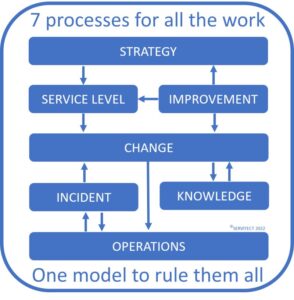
Two common failures of process models: Not holistic and too complex. If models are not holistic they miss essential parts, the chain is not complete.If models are too complex they are not applicable and therefore useless. It’s a fragile balance…
Use clear goals
 IT service management models should support the delivery of valuable IT services, not fill the gap off unskilled people or uncertain leaders.
Using clear goals in terms of customer value will guide professionals and leaders to apply their skills wisely.
Strategy is an essential process
If clear strategy and policies are not available everyone has a though job to apply their skills in the right direction. Therefore “Strategy” is an essential process in the model to assure the availability of clear policies and goals.If models are too complex to apply and can’t be explained easily, professionals and leaders will spend more time in details and discussions then in realizing customer value. So, keep it simple, but complete.

Wim Hoving
(Result-oriented connector
of People and Process,
architect of the ISM Method)