A proper process model is a co-operation model, essential to realize customer value. It’s not science! It should do the job! Complex models are killing for successful application. It’s not ideology, it’s about value and result.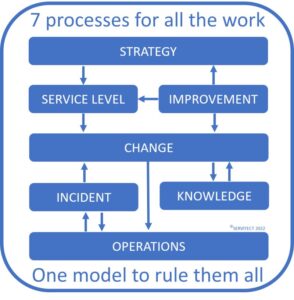 It’s an important part of the practice of an IT organization.Therefore it should be:
- Result oriented – if it not leads to value it has no value
- Applicable – if professionals can’t apply the model it won’t work
- Explainable – if it’s not understood there’s no co-operation
- Manageable – support leadership with shared values and views
- Measurable – as well in result as in flow
- Flow – describing the order of all activities, not the content
- Holistic – embracing all activities of the service chain
A proper process model really helps IT-organizations to realize customer value. That’s why we designed this ISM-model. No more than applicable, no less than necessary. So, keep it simple, but complete.

Wim Hoving
(Result-oriented connector
of People and Process,
architect of the ISM Method)